Stock Prices During Extended Hours: Previous Close & Current Price
A guide to the updated stock price types: what the previous close and current price mean and how to use them.
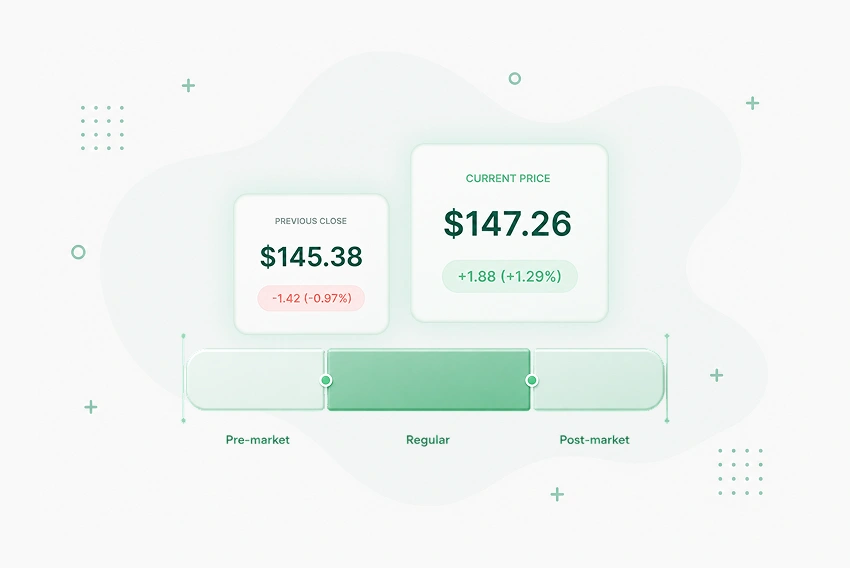
In the FinImpulse dashboard, the ticker page for each stock includes a header showing its price. Until recently, this price was presented as a single figure, the current price, which was sufficient for a stock active within its regular session. This display has now been updated: for some stocks, the current price is now shown together with a reference price from the regular session.
This article explains when this happens and how to interpret both figures correctly.
Background: Pre-Market, Regular, and Post-Market Sessions
A trading day on U.S. exchanges is organized into three sessions, each with a defined time window:
- Pre-market — 4:00-9:30 AM ET
- Regular — 9:30 AM-4:00 PM ET
- Post-market — 4:00-8:00 PM ET
Therefore, for certain stocks listed on U.S. exchanges, price movement is not confined to the regular session — pre- and post-market periods typically see lower volume, yet still produce meaningful shifts.
Outside these periods — overnight and on non-trading days — the market is considered fully closed.
All of this is reflected in the price figures FinImpulse displays for such stocks.
How to Read Price Figures for Stocks in FinImpulse
With the update, FinImpulse now shows different price figures for stocks listed on U.S. exchanges, depending on the current market state — an active session (pre-market, regular, post-market) or a fully closed market.
When Both Figures Are Shown
During pre-market or post-market sessions, FinImpulse shows two price figures together:
- Previous/At close price — the closing price of the regular session, a fixed value that does not change until the next regular session ends.
- Current price — the live price from the extended session in progress.
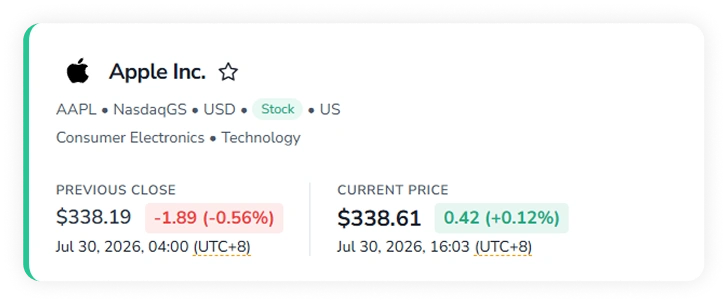
The closing price carries a different label depending on whether the market is about to open or has just closed. Before the market opens, it belongs to the previous, already completed regular session, so it is labeled “Previous Close.” After the market closes, it belongs to the session that has just ended, so it is labeled “At Close” instead. In both cases, the underlying value is the same regular session closing price — only the label changes to reflect its relationship to the current moment.
When Only the Current Price Is Shown
The current price is shown on its own in two situations:
- During the regular session — when the current price is the only price that matters, and a second figure would add nothing. The displayed change already reflects the difference from the previous close.
- Outside of any active session — when the market is fully closed, including after the post-market hours end, no live price exists at this point, so the closing price from the most recent session continues to be shown, labeled “Current Price.”
Prices for Stocks Outside the U.S. Market
Pre-market and post-market sessions are largely a U.S. exchange feature. Most exchanges outside the U.S. do not operate separate extended-hours sessions, so FinImpulse shows a single current price for non-U.S.-listed stocks by default.
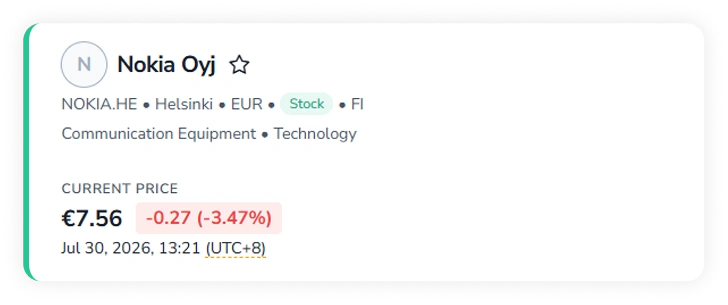
Where a non-U.S. exchange does define these session states, the same two-price display used for U.S.-listed stocks applies.
The Value of Tracking Both Prices
For U.S.-listed stocks, the current price on its own shows where it stands right now, but not how it got there. Adding the regular session’s closing price, along with the exchange state that produced each figure, makes it possible to gauge how far a stock has moved outside its regular session before that movement is reflected in the regular session itself. This is particularly relevant around earnings releases and other news that tends to affect prices before the market opens or after it closes.