SpaceX’s Nasdaq Listing Created a Trillionaire and Thousands of Millionaires
A look at SpaceX’s public listing, its ownership structure, and the market swings that followed it.

On June 12, 2026, SpaceX completed its initial public offering on the Nasdaq under the ticker SPCX, marking the largest stock market debut in history. The listing did more than set a new benchmark for IPO size: it also created the first trillionaire on record, as Elon Musk’s combined stake in SpaceX and Tesla pushed his net worth past $1 trillion. At the same time, an estimated 4,400 current and former SpaceX employees became millionaires through shares they held as part of their compensation.
In this article, we will look at how the offering was priced and structured, and how SPCX can be tracked and analyzed in the FinImpulse dashboard.
SpaceX IPO Price and First-Month Performance
SpaceX priced its shares at $135 each ahead of listing, implying an enterprise valuation of $1.77 trillion. Shares opened at $150 on June 12 and closed the first day at $161, a gain of about 19% from the IPO price that pushed the company’s market capitalization to roughly $2.1 trillion. The offering raised $75 billion, making it the largest IPO on record by a wide margin.
In the days that followed, SpaceX shares climbed further, reaching an intraday high of $225 on June 16 — a level at which the company’s market value surpassed both Amazon and Microsoft. The stock then declined as market participants weighed SpaceX’s underlying business performance against its AI-driven valuation narrative. By the end of its first month on the market, shares were changing hands at around $145, down more than 30% from the June peak.
How SpaceX’s IPO Created a Trillionaire and 4,400 Millionaires
The scale of wealth created by the listing was closely tied to how the offering itself was structured. Only about 5% of SpaceX’s total shares were made available to the public at listing, a notably smaller float than the 10% or more typically seen in large-cap IPOs. A smaller float means fewer shares are actively changing hands, which tends to make a stock’s price more sensitive to shifts in demand — a factor that likely contributed to the sharp price swings SpaceX experienced in its first weeks on the market.
This concentrated ownership structure also enabled the offering to generate such substantial wealth so quickly. Musk’s stake, combined with his holdings in Tesla, was valued at more than $1 trillion once SpaceX shares reached the public market, making him the first person in history to reach that threshold. Beyond Musk, thousands of SpaceX employees — including hourly workers and engineers who had received company stock as part of their compensation over the years — saw the value of their holdings rise substantially the moment shares went public, with an estimated 4,400 of them crossing the million-dollar mark, according to an analysis by Hill.com, a San Francisco-based investment platform (The New York Times).
Much of this wealth, however, remains inaccessible for now. Musk and other company insiders are subject to a 366-day lock-up period before they can sell shares, while other pre-IPO holders, including employees, face a staggered 180-day lock-up. As a result, the paper gains reported in the weeks following the IPO cannot yet be converted into cash. The eventual expiration of these lock-ups, expected to coincide with SpaceX’s first public earnings report, is likely to bring additional shares onto the market and, with them, further price movement.
SpaceX (SPCX) in the FinImpulse Dashboard
SPCX is available on the FinImpulse dashboard, where you can explore historical price data going back to the Nasdaq debut on June 12, alongside financial statements, valuation ratios, and statistics & risk — all in one place for tracking how the stock has developed since it went public.
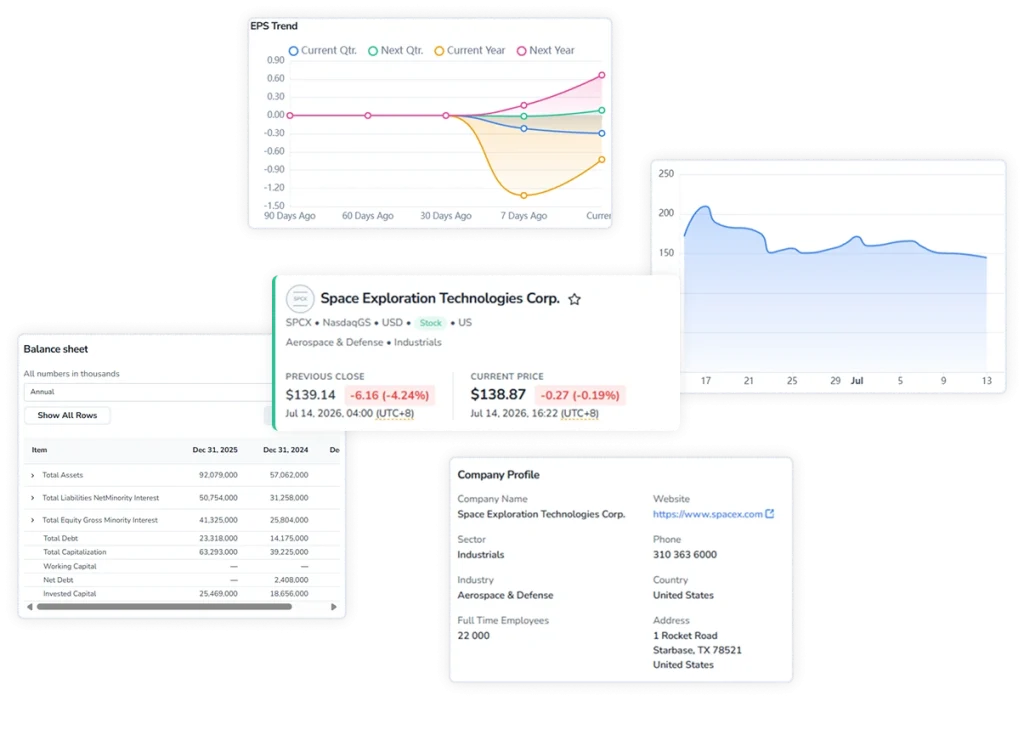
Beyond price history and financials, the dashboard surfaces analyst-driven data points, including analyst recommendations, price targets, earnings and revenue estimates, EPS trends, and recent upgrades or downgrades. Options data for SPCX is also available, giving a fuller picture of market activity around the stock.
You can also add SPCX to a personal watchlist to monitor it alongside other assets, or use FinImpulse’s AI search to explore related data points without navigating through each section manually.