
Latin American Exchanges: Structure, Characteristics, and Regional Context
An overview of Latin America’s exchanges, their structural characteristics, and what sets them apart as emerging markets.

Latin America spans six major exchanges, dozens of listed asset classes, and economies that range from one of the largest commodity exporters in the world to smaller, regionally integrated markets.
The region holds a defined place in the global financial landscape — substantial in scale, yet structurally distinct from developed markets in its liquidity profile, volatility patterns, and regulatory environment. That distinction begins with how these markets are classified.
Why Latin American Markets Are Classified as Emerging
The term “emerging market” has a specific technical meaning in finance — it refers to economies that are developing toward the institutional standards of mature markets but have not yet reached them. In practice, this means lower market capitalization relative to GDP, less liquid trading environments, higher exposure to currency risk and political cycles, and regulatory frameworks that are still evolving.
Latin America sits firmly within this classification. The MSCI Emerging Markets Latin America Index — one of the primary benchmarks used by institutional participants to track the region — includes equities from Brazil, Chile, Colombia, Mexico, and Peru. This is not a casual label: inclusion in the index reflects a formal assessment of market accessibility, liquidity thresholds, and market accessibility criteria.
The classification matters for how analysts and data practitioners work with these markets. Unlike the major developed exchanges — NYSE, Nasdaq, Euronext — LatAm markets carry a distinct risk profile, a different data cadence, and a structural sensitivity to macroeconomic factors that requires explicit accounting in any analytical workflow.
Characteristics of LatAm Markets
Latin American exchanges share several structural characteristics that set them apart from developed markets:
- Lower liquidity and market scale
- Evolving regulatory frameworks
- Higher volatility driven by cyclical and macroeconomic factors.
Lower liquidity is visible across the board — fewer actively traded companies, higher ownership concentration, and a thinner institutional participant base translate into wider bid-ask spreads, slower price discovery, and historical data that often requires cleaning before use.
Regulatory frameworks have advanced over the past two decades, but they still diverge from US and EU standards in disclosure requirements, corporate governance norms, and enforcement consistency, affecting the comparability of fundamental data across issuers.
Volatility is structurally higher, driven by commodity dependence in several economies, sensitivity to US monetary policy through dollar-denominated debt, and political cycles that can produce sharp shifts in fiscal and regulatory conditions.
Key Latin American Exchanges
Six exchanges form the core of Latin America’s market infrastructure:
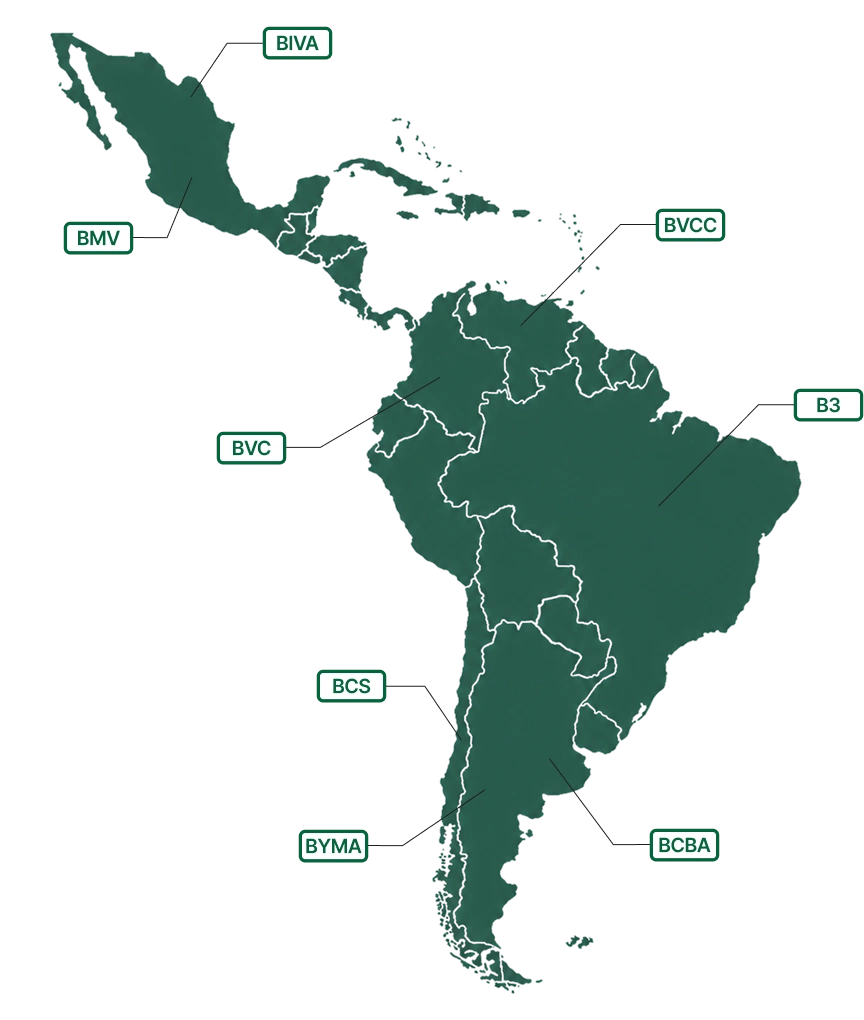
Brazil — B3 (Brasil, Bolsa, Balcão)
B3 is the dominant exchange in Latin America by market capitalization, daily trading volume, and the breadth of listed instruments. The exchange traces its current form to a series of consolidations: the 2008 merger of the São Paulo Stock Exchange (Bovespa) with the Brazilian Mercantile and Futures Exchange (BM&F) created BM&FBovespa, which subsequently merged with the clearinghouse Cetip in 2017 to form B3. Today it handles equities, fixed income, derivatives, and foreign exchange under one infrastructure.
B3 carries significant weight in regional indices and typically accounts for the largest share of LatAm benchmarks. For analysts covering the region, it functions as both the primary data source and a broad proxy for regional market conditions — movements in B3 often reflect shifts in commodity prices, global risk appetite, and Brazilian macroeconomic cycles simultaneously.
Chile — Bolsa de Comercio de Santiago
The Santiago Stock Exchange (BCS) is among the most stable and internationally connected exchanges in the region. Chile’s macroeconomic track record — fiscal discipline, controlled inflation, and relatively consistent regulatory standards — has produced a market with lower volatility than most of its regional peers and stronger alignment with international disclosure norms, including participation in the UN Sustainable Stock Exchanges Initiative.
For data work, BCS is one of the more straightforward LatAm environments: price series tend to be more continuous, corporate filings more consistent, and currency dynamics less distorted than in several neighboring markets. It is also a founding member of MILA, the regional cross-border trading infrastructure linking Chile, Colombia, Peru, and Mexico.
Mexico — Bolsa Mexicana de Valores (BMV) and BIVA
Mexico is the second-largest equity market in Latin America by market capitalization and the only country in the region with two active stock exchanges operating in parallel. The Bolsa Mexicana de Valores (BMV) is the established venue, handling the bulk of listed equities and fixed income instruments. BIVA, launched in 2018, introduced direct competition and has contributed to tighter spreads and broader market access.
Mexico is included in the MSCI Emerging Markets Latin America Index and is also a member of MILA. Its proximity to the US economy — through trade linkages, remittance flows, and dollar-denominated debt — means Mexican market data is particularly sensitive to shifts in US monetary policy and trade conditions, a factor that shapes how price and performance data behaves over macroeconomic cycles.
Argentina — Bolsa de Comercio de Buenos Aires (BCBA) and Bolsa y Mercados Argentinos (BYMA)
Argentina’s exchange landscape is structurally more complex than most in the region. The Buenos Aires market operates under persistent macroeconomic pressure — chronic inflation, periodic currency devaluations, and capital controls have shaped both the behavior of listed equities and the practical accessibility of the market for international participants. BYMA handles the bulk of electronic equity transactions and serves as the primary venue for Argentine equities.
The data environment here requires particular care. Argentina has maintained multiple concurrent exchange rates at various points in its recent history, creating a gap between official and parallel market valuations that directly affects how prices, performance figures, and market capitalization translate into USD-comparable terms. Normalization is not a routine step — it requires an explicit understanding of which rate applies to a given instrument, time period, and transaction type.
Colombia — Bolsa de Valores de Colombia (BVC)
The Colombian Stock Exchange is a mid-sized market within the LatAm context. Its economy is commodity-driven — oil exports are a primary source of revenue — which means BVC equity performance tends to correlate with global energy prices and is sensitive to the same macro cycles that affect other resource-dependent markets in the region.
BVC is a founding member of MILA, the cross-border trading infrastructure shared with Chile, Peru, and Mexico. This integration has increased the effective liquidity and market reach of the Colombian market, making it particularly relevant for cross-market workflows within the Pacific Alliance economies.
Venezuela — Bolsa de Valores de Caracas
The Caracas Stock Exchange remains formally operational, but its practical relevance for data-driven analysis is limited. Hyperinflation, capital controls, and prolonged economic contraction have reduced trading activity, distorted pricing mechanisms, and constrained the availability of reliable, comparable data.
Venezuela is nonetheless worth noting in a regional overview. Its trajectory illustrates how sustained macroeconomic stress — currency collapse, capital flight, and regulatory instability — affects market structure and data availability over time, and provides context for understanding the outer range of conditions that emerging market data can reflect.
Analyzing LatAm Markets: Key Considerations
The structural characteristics described in this article define the analytical parameters for working with the region, not reasons to avoid it. Latin America represents a substantial share of global emerging-market exposure, with assets spanning energy, materials, financials, consumer goods, and agribusiness across markets that are significant in both size and sectoral breadth.
Working with LatAm data effectively means treating these characteristics as inputs rather than obstacles. Currency normalization, macro context, and data quality are not edge cases in this region — they are baseline considerations that shape how results are interpreted. Analytical frameworks built for more stable environments tend to need adjustment here, and that adjustment is part of what working with emerging markets requires.