Multiple Listings of the Same Company
A clear explanation of why companies list on several markets and what that means for data coverage and access.

Today, many global companies are listed on multiple stock exchanges, allowing market participants worldwide to access their shares in local currencies and markets.
This article explains how these listings work and what they mean for data interpretation.
Global Listings Explained
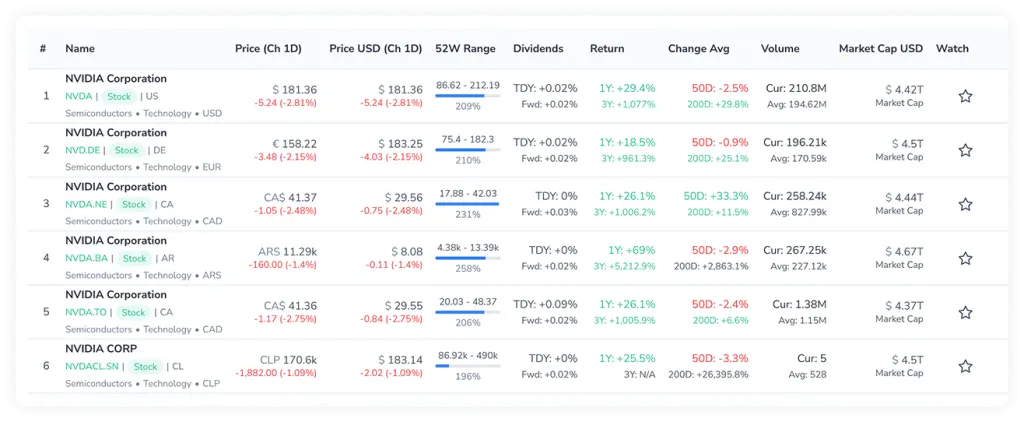
Large global companies (e.g., NVIDIA, Apple, Microsoft) are often listed on multiple stock exchanges worldwide. There are three main forms of multi-listing:
- Primary listing — the company’s original market (e.g., NVIDIA: NVDA on NASDAQ, US).
- Secondary listings — shares listed on other exchanges, usually in local currencies (e.g., NVDA.TO in Canada, NVDA.BA in Argentina).
- Depositary receipts (ADR/GDR) — certificates traded on international exchanges (e.g., in London or Frankfurt) that represent ownership of the original shares. ADRs (American Depositary Receipts) are primarily traded in the U.S., while GDRs (Global Depositary Receipts) are available on other international markets.
How to Identify the Main Ticker?
- The primary ticker is always tied to the company’s home exchange. U.S. tech stocks → NASDAQ or NYSE
- Secondary tickers include suffixes showing the local market: .TO (Toronto), .BA (Buenos Aires), .BK (Bangkok), .LI (Switzerland)
- All versions share the same ISIN (International Securities Identification Number), which serves as the global identifier for a security.
Not all companies have all three forms of listing; some may only have a primary and depositary listing, or a primary and secondary listing.
Why Does FinImpulse Show All Listings?
Unlike many platforms that only display the primary ticker, FinImpulse reveals all available listings across global exchanges. This has two advantages:
- Local access — if you are based in Warsaw, FinImpulse shows whether NVIDIA shares are listed in PLN on a local exchange.
- Complete transparency — you can see how and where the company is listed worldwide, which is especially useful for cross-market data analysis.
Practical Tips
- Use the primary ticker for global reference.
- Explore secondary listings to check if a local exchange offers access in a specific currency or market.
- Keep in mind that listing the same company on different exchanges may involve varying fees, different market hours, and price discrepancies due to currency fluctuations.
In Summary
Multiple listings expand where a company’s shares can be accessed, but the underlying security remains the same. Currency, fees, and market hours differ by exchange; the ISIN does not.
Understanding multiple listings provides a complete view of where a company is listed globally and what local access points exist.