

Nasdaq vs NYSE vs NYSEArca vs NYSE American: Key Differences Explained
A breakdown of how the major American trading venues differ in structure, listings, and the instruments they serve.
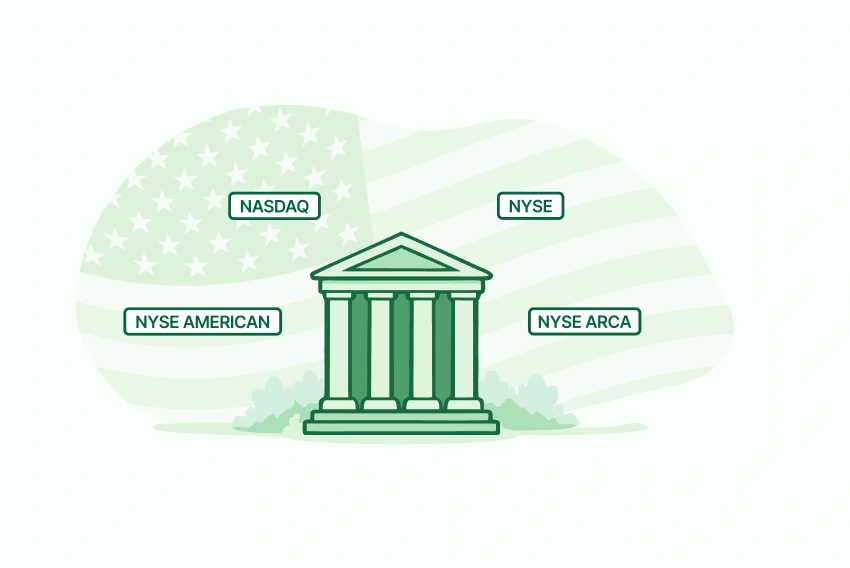
The U.S. market operates through several distinct exchanges — each with its own listing requirements, trading model, and asset focus.
Nasdaq, NYSE, NYSE American, and NYSEArca are not interchangeable names for the same marketplace. They serve different types of companies and instruments, and understanding the distinctions between them matters for anyone working with U.S. market data.
Structure of the U.S. Market
The U.S. operates through a fragmented system of registered national securities exchanges, each regulated by the SEC. Trading activity is distributed across these venues, and the same security can technically be quoted on multiple platforms — though it is formally listed on only one.
The four exchanges covered in this article are among the most widely referenced in U.S. equity and ETF markets. They differ in trading mechanics, listing standards, and the types of companies and instruments they attract.
Nasdaq
Nasdaq was founded in 1971 as the world’s first fully electronic stock exchange. It operates entirely through a dealer market model — meaning trades are facilitated by market makers who continuously quote bid and ask prices for listed securities. There is no physical trading floor.
This structure made Nasdaq the preferred listing venue for technology and growth-oriented companies. Apple, Microsoft, and Nvidia are among the large-cap names listed here, though the exchange spans a broad range of sectors.
Nasdaq organizes its listings into three market tiers, each with distinct requirements:
| Tier | Full Name | Profile |
|---|---|---|
| NasdaqGS | Nasdaq Global Select Market | Highest listing standards — large-cap companies, strict financial and governance requirements |
| NasdaqGM | Nasdaq Global Market | Mid-tier — smaller than GS, but with sufficient capitalization and liquidity |
| NasdaqCM | Nasdaq Capital Market | Lowest tier — designed for smaller and early-stage public companies |
The tiered structure allows Nasdaq to serve companies at different stages of development under a single exchange umbrella, while maintaining differentiated standards across segments.
Nasdaq GIDS: A Data Service, Not an Exchange
When working with market data, the identifier “Nasdaq GIDS” (Global Index Data Service) occasionally appears alongside exchange names.
GIDS is Nasdaq’s data distribution service for indices, ETF indicative values, and benchmark data. Securities are not listed on GIDS — it is a data distribution channel, not a trading venue.
NYSE
The New York Stock Exchange is the largest stock exchange in the world by market capitalization of listed companies. Unlike Nasdaq, NYSE operates as an auction market — prices are determined by matching buy and sell orders, with designated market makers (DMMs) responsible for maintaining fair and orderly trading in assigned securities.
NYSE uses a hybrid model: while trading is predominantly electronic, it retains a physical trading floor at 11 Wall Street in New York. The floor plays a largely ceremonial role today, but DMMs remain an active part of the market structure.
NYSE is the primary listing venue for large, established companies — blue-chip names across financials, industrials, consumer goods, and healthcare. Johnson & Johnson and Coca-Cola are among the well-known names listed here. Listing requirements are among the most stringent of any U.S. exchange, reflecting the venue’s institutional character.
Compared to Nasdaq, NYSE is generally associated with more mature companies and a more conservative investor base, though both exchanges cover a broad range of sectors and market caps.
NYSE American
NYSE American — formerly known as the American Stock Exchange (AMEX) — operates as a separate exchange within the NYSE Group. It is designed for smaller companies that do not meet the listing requirements of the main NYSE market. Listing standards are lower across capitalization, revenue, and governance criteria, making it accessible to small-cap and micro-cap issuers, as well as companies at earlier stages of development.
In terms of market positioning, NYSE American is broadly comparable to Nasdaq Capital Market — both serve as entry-level listing venues within their respective exchange groups, with similar profiles of listed companies.
NYSE American also lists options and ETFs, though it is not the primary venue for either asset class in the U.S. market.
NYSEArca
NYSEArca is a fully electronic exchange operated by NYSE Group. It functions as the primary U.S. listing venue for exchange-traded funds and exchange-traded products.
The majority of large U.S.-listed ETFs trade on NYSEArca — including SPY (SPDR S&P 500 ETF Trust), one of the most liquid securities in the world. The exchange’s fully automated structure supports high-speed order execution, which aligns with the trading patterns typical of ETF markets.
While NYSEArca also lists equities, its role in the U.S. market is most closely associated with ETF infrastructure. For anyone working with ETF data, NYSEArca will appear as the listed exchange for a significant portion of the instrument universe.
Side-by-Side Comparison
| Exchange | Trading Model | Asset Focus | Key Characteristic |
|---|---|---|---|
| Nasdaq | Dealer market (market makers) | Tech, growth equities | Fully electronic; three listing tiers (GS, GM, CM) |
| NYSE | Auction market (DMMs) | Large-cap, blue-chip equities | Hybrid model; physical floor retained |
| NYSE American | Auction market | Small-cap, micro-cap equities | Lower listing requirements; comparable to NasdaqCM |
| NYSEArca | Electronic | ETFs, ETPs | Primary U.S. ETF listing venue |
The Takeaway
Nasdaq, NYSE, NYSE American, and NYSEArca operate within the same regulatory environment but serve distinct functions in the U.S. market. They differ in trading mechanics, listing standards, and the types of instruments they attract.
These distinctions matter both for understanding how U.S. markets are structured and for working accurately with the data they produce.