

Financial Exchanges: Types, Differences, and How They Work
A breakdown of how financial exchanges work — auction markets, ECNs, OTC trading, and how they differ by asset class.
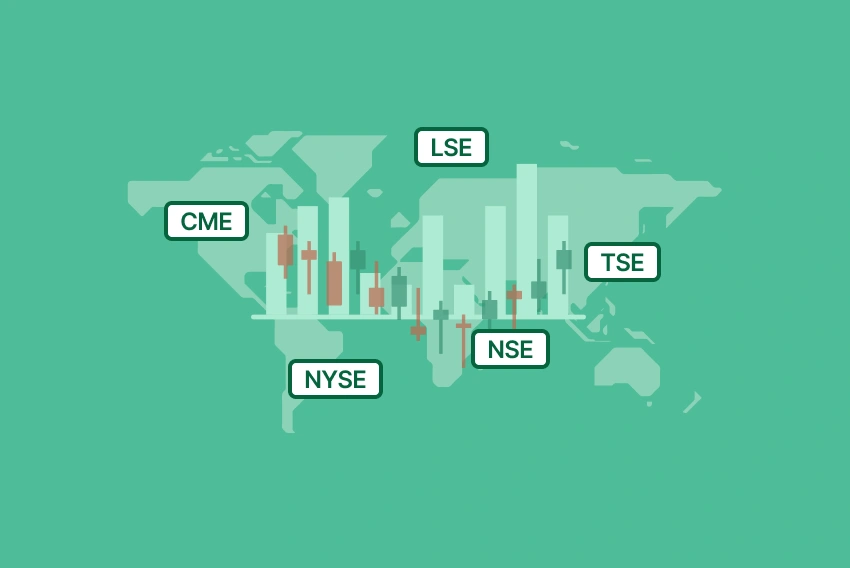
Every time a share of stock changes hands, that transaction flows through a defined structure. It might be a regulated exchange, a dealer network, or an electronic system — but there’s always infrastructure behind the trade.
Understanding how these structures work is foundational for anyone analyzing markets, building financial tools, or working with market data.
Understanding Exchanges
An exchange is an organized marketplace where financial instruments are bought and sold under defined rules. It provides the infrastructure for transactions to happen efficiently, at scale, and with a degree of transparency that informal trading cannot offer.
Exchange vs. Stock Exchange
The term “exchange” is broader than “stock exchange.” A stock exchange specifically lists and trades equity securities. In the general sense, an exchange can operate across asset classes such as:
- Equities
- Futures
- Options
- Commodities
It may combine several of these under one roof, for example, as CME Group or Euronext does.
Exchange vs. Financial Market
An exchange is not the same as a financial market. A market encompasses all trading activity in a given asset class or region: exchange-listed instruments, over-the-counter transactions, and alternative trading systems. An exchange is one component of that market — its most formal and regulated layer.
Why Exchanges Exist
Exchanges solve a coordination problem: how do buyers and sellers find each other, agree on a price, and complete a transaction reliably? Three functions make that possible:
- Price discovery: Prices form as buy and sell orders interact in real time, reflecting what the market collectively thinks an asset is worth.
- Liquidity: Centralized order flow means enough participants are always present on both sides, enabling faster execution and tighter spreads.
- Transparency: Listed companies must meet defined disclosure requirements, giving investors access to standardized, comparable information.
Trading Infrastructure: Auction Markets, ECNs, and OTC
Trading on an exchange isn’t a single, uniform process. The model varies, and that variation affects how prices form, who can participate, and when trades can happen.
Auction Markets
Most major exchanges operate as auction markets. The core idea is straightforward: the exchange collects buy orders and sell orders, then matches them when prices align. Price is determined by actual supply and demand.
In practice, auction markets can look different from each other:
- NYSE still has designated market makers on its trading floor who can intervene during volatile moments or at open and close.
- Nasdaq, by contrast, is fully electronic — there’s no physical floor, and matching happens algorithmically.
Both are auction markets. The difference is in the execution infrastructure.
Electronic Communication Networks (ECNs)
ECNs are electronic systems that match orders outside the main exchange venues. They’re regulated, but access is mostly limited to broker-dealers and institutional participants — retail investors reach them through their brokers.
The most relevant practical difference is that ECNs enable trading outside standard exchange hours. Pre-market and after-hours sessions run through these systems. Liquidity during those windows is thinner, and execution quality varies.
Over-the-Counter (OTC) Markets
OTC trading happens outside any formal exchange. There’s no central venue — transactions are negotiated directly between parties through broker-dealer networks.
This structure has consequences:
- Prices aren’t publicly discovered through an order book — they’re agreed upon bilaterally
- There’s no central clearinghouse absorbing counterparty risk
- Disclosure requirements for OTC-traded companies can be less stringent than those for listed companies
OTC markets aren’t marginal — a significant share of global bond and derivatives trading happens this way. But the data environment is less standardized.
Types of Exchanges by Asset Class
Beyond the mechanics of trading, exchanges also differ in what they trade. Each asset class has its own exchange infrastructure, with distinct characteristics:
- Equity exchanges list shares of publicly traded companies and handle the majority of global stock trading. NYSE, Nasdaq, the London Stock Exchange, and the Tokyo Stock Exchange are all equity exchanges.
- Derivatives exchanges specialize in futures and options contracts. These instruments derive their value from an underlying asset — a stock, index, commodity, or interest rate. CME Group (Chicago), Eurex (Frankfurt), and ICE (Intercontinental Exchange) are the major players. Derivatives markets are essential for hedging and risk management across industries.
- Commodity exchanges facilitate trading in physical goods and their derivatives — oil, natural gas, metals, agricultural products. Some commodity exchanges, like the London Metal Exchange (LME), deal in physical delivery. Others primarily trade financially-settled futures contracts.
- Crypto exchanges are structurally distinct from all of the above. They operate largely outside the regulatory frameworks that govern traditional financial markets. Many run 24/7 with no settlement cycle, no central counterparty, and — in the case of decentralized exchanges (DEXs) — no central operator at all.
Crypto assets carry a distinct risk profile: elevated short-term volatility, less consistent long-term signals, and pricing dynamics that differ materially from those of traditional asset classes.
That’s why FinImpulse focuses on equities, ETFs, and mutual funds — asset classes where formalized disclosure requirements and regulated exchange infrastructure make systematic, reliable analysis possible.
Major Global Exchanges
Exchanges are distributed across regions, and each major hub reflects the economic and regulatory environment of its jurisdiction.
| Exchange | Region | Notable for |
|---|---|---|
| NYSE | United States | Largest by market cap; home to many blue-chip multinationals |
| Nasdaq | United States | Technology-heavy; first fully electronic major exchange |
| Euronext | Europe (multi-country) | Operates across Amsterdam, Paris, Brussels, Lisbon, Dublin, Oslo, Milan |
| London Stock Exchange (LSE) | United Kingdom | Major hub for international listings and fixed income |
| Deutsche Börse / Xetra | Germany | Primary venue for German equities; electronic trading focus |
| Tokyo Stock Exchange (TSE) | Japan | Largest exchange in Asia by market cap |
| Hong Kong Exchanges (HKEX) | Hong Kong | Key access point for international investors to Chinese equities |
| National Stock Exchange (NSE) | India | One of the fastest-growing markets by trading volume |
The Takeaway
Exchanges are the infrastructure layer of financial markets. They determine how prices form, who can trade, and what data gets generated as a result. None of that is uniform across markets — and those differences have consequences for anyone working with financial data.
That’s the context in which FinImpulse is built.