
Normalized Dividend Metrics in the FinImpulse Dashboard
A breakdown of two new USD-normalized dividend metrics in the FinImpulse dashboard’s search.

Comparing dividend-paying assets across global markets requires a common unit of measurement. Dividend yield, expressed as a percentage, is inherently currency-neutral, but it represents a ratio, not an absolute amount. For analysis that depends on the actual per-share dividend amount a position produces, yield alone is insufficient.
FinImpulse covers 98 global markets with data normalized in USD across prices, market caps, and performance metrics. That normalization now extends to dividend rates. Two new metrics are available in the dashboard search: Forward Dividend Rate USD and Trailing Dividend Rate USD.
Metrics Overview
Both metrics are available in the dashboard search under Add Filters → Performance and in the column chooser in the results table.
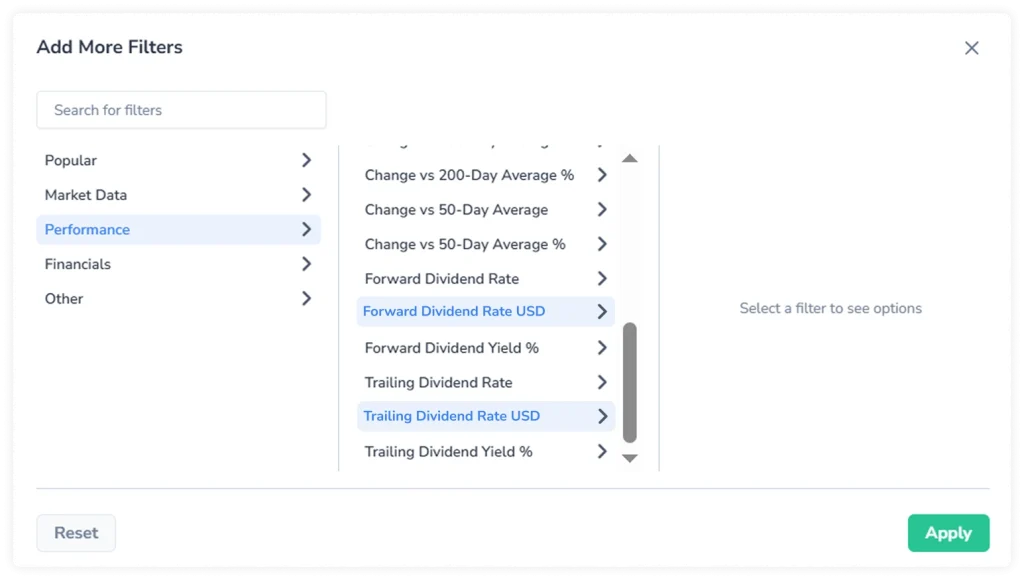
- Forward Dividend Rate reflects the projected annual dividend per share, expressed in USD. It is derived from the most recently declared dividend, annualized based on the payment frequency. This is a forward-looking figure — it represents what the company is expected to pay over the next 12 months, based on current dividend policy.
- Trailing Dividend Rate reflects the actual dividend per share paid over the past 12 months, expressed in USD. It is a historical figure derived from completed payments, not projections.
Both values are normalized from the asset’s local currency into USD using current exchange rates.
Why USD-Normalized Dividend Rates Matter
As previously mentioned, dividend yield is a ratio — annual dividend divided by share price — expressed as a percentage. It is useful for comparing dividend amounts relative to share prices and is inherently currency-neutral. However, it does not convey the absolute income generated per share.
When analyzing assets across multiple markets, yield alone has limitations. Two assets can show identical yields while producing significantly different dividend amounts in absolute terms, depending on their share prices. Conversely, an asset with a modest yield on a high-priced share may produce a higher dividend amount per share than a high-yield asset priced lower.
USD-normalized rate metrics express the dividend amount as an absolute figure in a consistent currency, making it possible to compare the actual per-share dividend of a Japanese stock against a Canadian ETF or a UK-listed fund without manual currency conversion.
The distinction between forward and trailing figures adds a further analytical dimension. The Forward Dividend Rate USD reflects the company’s current dividend policy — what it has indicated it will pay. Trailing Dividend Rate USD reflects what was actually paid. The gap between the two, where it exists, can indicate a recent change in dividend policy: an increase, a reduction, a suspension, or a reinstatement. Neither metric replaces the other; used together, they provide a more complete picture of dividend behavior.
Practical Use Cases
USD-normalized dividend rates support a range of analytical tasks that yield-based metrics alone do not cover. Below are several examples of how these filters can be applied in practice.
- Comparing dividend amounts across markets: When reviewing assets across multiple countries simultaneously, working in a single currency eliminates the need for manual conversions and enables direct comparison of per-share dividend amounts.
- Tracking changes in dividend policy: A meaningful difference between the forward and trailing figures for the same asset can indicate that a company has recently adjusted its dividend. Filtering for assets where these two values diverge by a defined threshold can surface companies with recent dividend changes — either upward or downward.
- Screening income-generating assets by absolute payout: For analysis focused on absolute dividend amounts rather than yield ratios, filtering by a minimum Forward Dividend Rate (USD) or Trailing Dividend Rate USD allows the search to be defined in terms of actual cash amounts per share, denominated in a consistent currency.
- Analyzing ETFs and funds alongside equities: ETFs and mutual funds distribute income on different schedules and in different base currencies. Normalizing dividend rates to USD makes it possible to place equities, ETFs, and funds in the same search view with directly comparable dividend figures.